
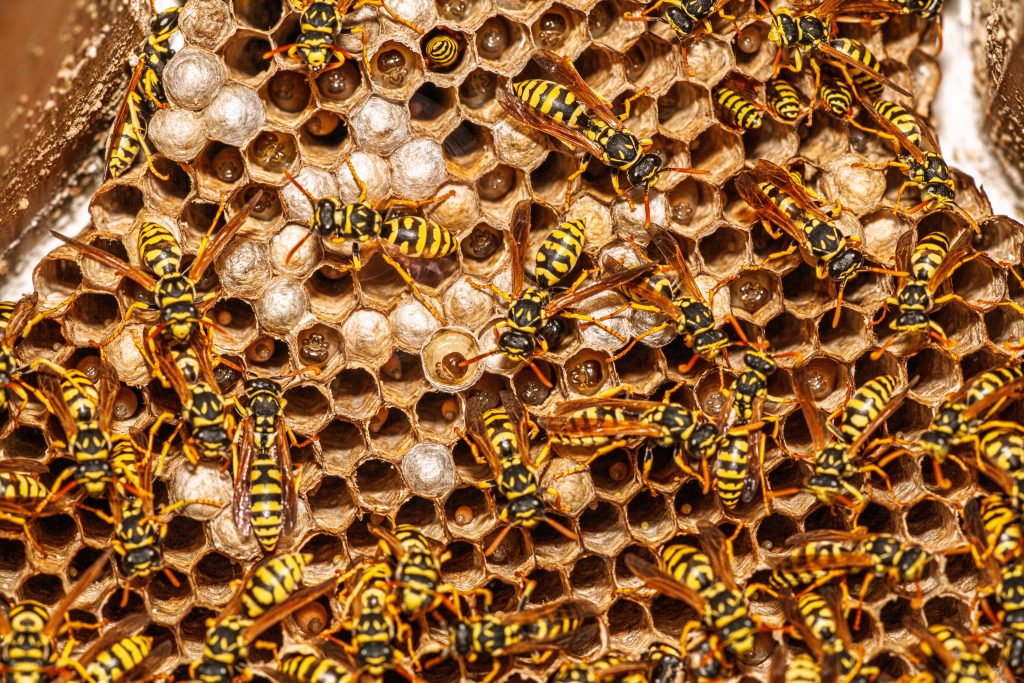
A wasp circling your porch does not tell you much by itself. Watch where it goes, though, and the picture gets clearer. A wasp slipping beneath a deck rail, entering a hole in the lawn, or returning to the same corner of an eave can tell you what type of nest may be nearby.
Wasps in SC include both social species that live in colonies and solitary species that work alone. That distinction matters around a home. Paper wasps and yellow jackets defend shared nests, while mud daubers and cicada killers spend most of their time hunting prey and rarely bother people unless handled.
This guide will help you identify the most common wasps in South Carolina, recognize their nests, understand when activity increases, and decide when a wasp problem needs professional attention.
Common Types of Wasps in SC
South Carolina has both social and solitary wasps. Paper wasps, yellow jackets, and bald-faced hornets live in colonies where workers help protect a shared nest. Mud daubers and cicada killers work alone, so they behave quite differently around people.
You rarely need to get close enough to study tiny markings. From a safe distance, look at the insect’s size, flight path, and especially the type of nest it keeps returning to.
| Wasp | Where You Commonly See the Nest | Best Identification Clue | Behavior Around People |
| Paper wasp | Eaves, porch ceilings, deck rails, shrubs | Open paper comb with visible cells | Defends the nest when disturbed |
| Yellow jacket | Ground cavities, wall spaces, hollow areas | Heavy traffic through one small opening | Strong nest-defense behavior |
| Mud dauber | Garages, sheds, walls, covered surfaces | Hardened mud tubes or cells | Solitary and usually calm |
| Bald-faced hornet | Trees, shrubs, elevated structures | Large enclosed paper nest | Defensive close to the colony |
| Cicada killer | Sunny, dry soil | Large wasp using an individual burrow | Solitary and rarely bothers people |
Paper Wasps
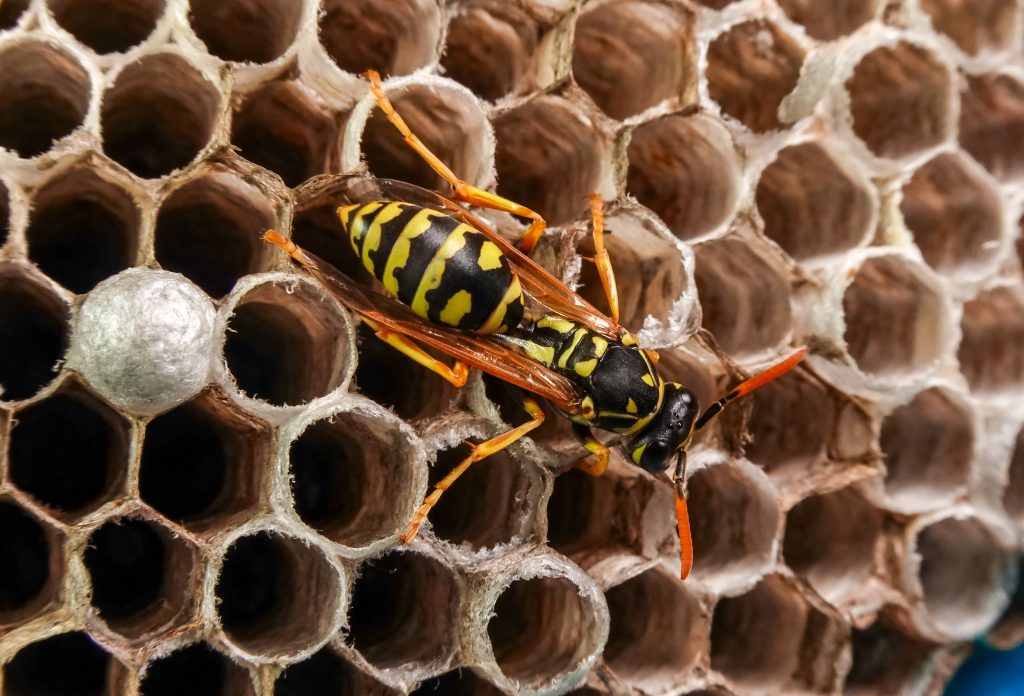
Paper wasps often settle in places you walk beneath every day. Check porch ceilings, deck framing, railings, door frames, attic rafters, and roof overhangs. Their nests look like small paper umbrellas, with the individual cells exposed instead of enclosed inside an outer shell.
Their narrow bodies and long legs are another useful clue. Adults feed on nectar, while workers collect caterpillars and other insects for developing larvae. Clemson University notes that paper wasps can benefit gardens by feeding on plant pests, although a nest close to a doorway or seating area can still create a sting concern.
A nest under a quiet corner of the roof may never interfere with you. One beside the patio door puts you close to the colony every time you step outside.
Yellow Jackets
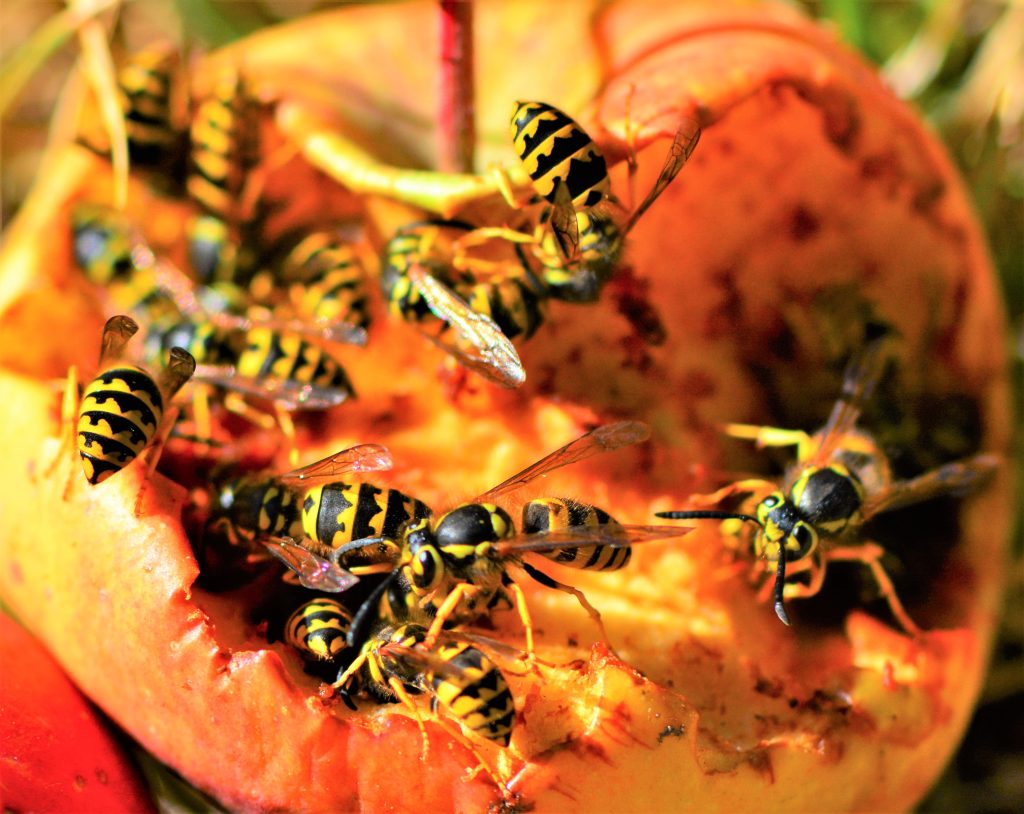
Yellow jackets are stockier than paper wasps and usually have bold yellow and dark markings. Many yellow jacket nests stay completely hidden. You might see nothing more than a hole in the lawn, a gap near siding, or workers disappearing into a protected cavity.
Ground wasps are often noticed during ordinary yard work. You push the mower toward one section of grass and suddenly see steady traffic near the soil. That small entrance can lead to a much larger yellow jacket colony below ground.
Clemson’s guidance on yellow jackets and paper wasps explains that colonies grow through summer and generally reach their largest worker populations in fall. That is when yellow jackets can become much easier to notice around nest entrances, outdoor meals, trash cans, fallen fruit, and sweet drinks.
Mud Daubers

Mud daubers leave behind one of the easiest wasp nests to recognize. Females build tubes or clumps from mud rather than paper. You may find them attached to a garage wall, inside a shed, beneath a porch, or on another dry surface protected from heavy rain.
The wasps themselves often have extremely thin waists. Females hunt spiders and store them inside individual cells as food for their young.
Because mud daubers are solitary, there is no large worker colony guarding the nest. They are generally less defensive around people than paper wasps or yellow jackets. The mud itself may be unwanted on siding or trim, but the insects usually create a different kind of problem from a social wasp colony beside a walkway.
Bald-Faced Hornets

Bald-faced hornets are black-and-white social wasps that build enclosed paper nests. Despite their common name, they are a type of yellow jacket. Their gray nests often hang from tree limbs, shrubs, or elevated areas near structures.
Cicada Killers
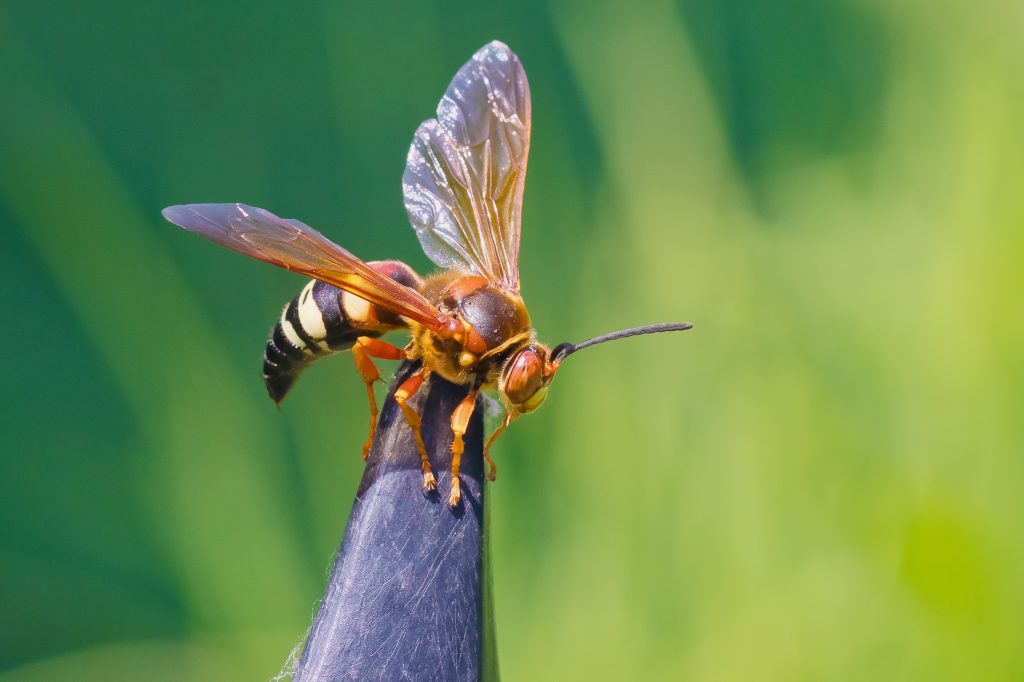
Cicada killers get attention because of their size. Females dig individual burrows in sunny soil and hunt cicadas to feed their young. They are solitary wasps, not members of one shared underground colony.
Several cicada killers can use the same patch of ground without sharing a nest. That distinction helps separate them from yellow jackets, where many workers repeatedly use one colony entrance.
Where Wasps Build Nests Around South Carolina Homes
Two-story homes offer plenty of sheltered nesting spots. Upper eaves, porch roofs, deck joists, window trim, shutters, soffit gaps, sheds, and dense shrubs all give wasps protection from weather and regular disturbance.
If you see repeated activity, stay several feet back and watch the flight path. Where the insects land often tells you more than their color.
| Where You See the Wasps | Likely Possibility | What You Might See |
| Beneath an eave | Paper wasps | Exposed comb tucked against the structure |
| Under a deck rail | Paper wasps | Workers disappearing beneath the wood |
| One small lawn opening | Yellow jackets | Frequent two-way traffic |
| Dry patch of bare soil | Cicada killers | Separate burrows with loose soil nearby |
| Tree or large shrub | Bald-faced hornets | Enclosed gray paper nest |
| Garage or shed wall | Mud daubers | Dry mud tubes or clustered cells |
| Soffit or siding gap | Social wasps | Repeated entry through one structural opening |
A wasp visiting flowers is usually just feeding. Its nest could be well beyond your yard.
Repeated traffic to the same section of siding, soil, or roofline deserves more attention. If workers continually disappear through a soffit or wall gap, the visible opening may lead to a concealed nest rather than a small nest you can inspect from outside.
When Wasp Activity Picks Up in South Carolina
Spring starts quietly for many social wasps. Queens begin new colonies and handle much of the early nest building, egg laying, and food gathering themselves. At that stage, a paper wasp nest under an eave may contain only a few cells.
Summer brings more workers. Once they mature, they take over much of the hunting and nest work. You start seeing more flights across the yard and more movement around established nest entrances.
Late summer and fall tend to make social wasp activity much harder to miss. Yellow jacket colonies contain more workers, and the insects may show up around cookouts, garbage cans, dropped fruit, sugary drinks, and other easy food sources.
Cold weather eventually shuts down most annual colonies. Mated queens survive in protected locations and establish new nests later. The worker colony that occupied the old nest does not simply restart the following spring.
How Much of a Sting Risk Do South Carolina Wasps Pose?
The level of risk depends heavily on where the nest sits. A mud dauber nest high on a shed wall creates little everyday contact. A yellow jacket nest beside the mower route puts you close to defensive workers whenever you cut the grass.
Paper wasps, yellow jackets, and bald-faced hornets can sting when their colonies are threatened. Wasps can sting repeatedly, which means disturbing a social nest can result in more than one sting.
| Situation | What It Suggests | What You Should Do |
| Wasp feeding on flowers | Normal foraging | Give it space |
| Mud tubes on a quiet shed wall | Solitary mud dauber activity | Identify before removing |
| Paper wasp nest beside a doorway | Colony within regular foot traffic | Keep people away from the nest |
| Wasps entering one lawn hole | Possible yellow jacket colony | Avoid mowing or digging nearby |
| Large paper nest near a patio | Social colony close to a busy area | Keep children and pets clear |
| Wasps entering a wall gap | Possible concealed colony | Avoid sealing the opening yourself |
Serious sting reactions are uncommon, but they can happen. A Centers for Disease Control and Prevention analysis recorded 788 U.S. deaths from hornet, wasp, and bee stings from 2011 through 2021, an average of 72 deaths per year. Those figures combine hornets, wasps, and bees rather than counting wasp stings alone.
For most homeowners, the more useful risk test is simple: can you use the yard, deck, doorway, or other part of the property without repeatedly passing close to the nest? A colony becomes more concerning when normal household routines bring people or pets into the same small area.
What to Do When You Find a Wasp Nest
Do not rush closer for a better look. You can learn plenty by watching where the wasps land, whether many insects use the same entrance, and whether the nest is made from paper, mud, or hidden from view.
Skip the broom and garden hose. Hitting or soaking an active social nest can trigger a defensive response while you are still standing nearby. Ground nests are even harder to judge because nearly the entire colony stays out of sight.
Take Extra Care With Hidden Nests
A small gap in a soffit or siding can be only the entrance. If wasps are moving through that opening throughout the day, sealing it does not remove the colony behind the wall.
Do not assume you can judge the size of a hidden nest from the number of workers you see outside. A concealed colony is one of the situations where professional identification becomes more useful than DIY wasp nest removal.
Make Busy Areas Less Attractive
Walk around the exterior occasionally during warm weather. Look beneath porch roofs, eaves, deck rails, play structures, and outdoor furniture before a small nest grows into something you cannot easily avoid.
Keep garbage containers closed and wipe up food or drink spills after eating outside. Trim thick shrubs around doors, walkways, and seating areas so you can spot nests before brushing against them.
Repair damaged screens and suitable exterior gaps after you know no active colony is using them. These steps will not remove every wasp from the property, but they can reduce some of the protected nesting spaces closest to the house.
When to Call for Professional Wasp Control in South Carolina
Professional wasp control makes sense when a social colony is beside a door, deck, pool, play area, mower route, or another place your household uses regularly. Hidden nests and nests high on a second-story roofline also create access problems that are difficult to handle safely from the ground.
ClearDefense Pest Control identifies the pest and nesting area before choosing a treatment approach. Technicians can address wasps and hornets around structures, lawns, foliage, and eaves up to 25 feet, which is useful when the nest is concealed or hard to reach.
If wasps in SC have taken over a part of your home or yard that you use every day, contact ClearDefense Pest Control for an evaluation. You get a response based on the species, nest location, and activity around your property rather than trying to solve a hidden or hard-to-reach colony by guesswork.