
Wasps can cause costly problems when early signs are missed. Learn the start of a wasp nest, signs, risks, and when to call ClearDefense Pest Control.
Key Takeaways About Early-Stage Wasp Nests
- Catching a new wasp nest while it is still small gives you the best chance to address it before the colony grows. Paper wasp nests can hold up to about 100 wasps at full size, so early action matters.
- Wasps can build nests in a range of spots around your home, including eaves, enclosed voids, and other sheltered areas. Knowing where to look helps you spot a new nest sooner.
- Proactive exclusion, such as sealing gaps and cracks, is the most reliable way to keep wasps from nesting in attics, wall voids, and similar spaces.
- ClearDefense Pest Control offers recurring service with a guarantee against wasps and hornets, and technicians can treat eaves up to 25 feet.
How to Identify a Wasp Nest in Its Early Stages
Spotting a new wasp nest early gives you a better picture of what you are dealing with. The nest material, shape, and location can tell you which type of wasp is building. Knowing what to look for helps you decide on next steps before the nest grows.
How to Tell Different Wasp Types Apart
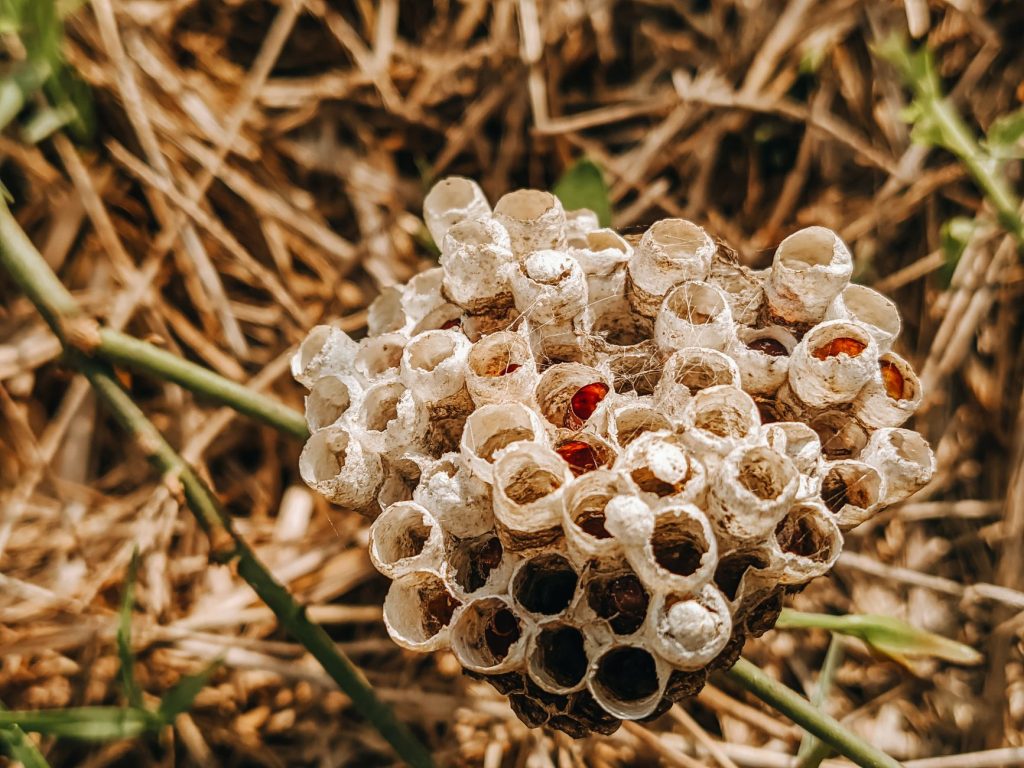
Paper wasps build open, umbrella-shaped combs out of papery material. A single queen, or sometimes a small group of queens, may start a nest. When several females begin building together, one becomes the dominant egg-layer while the others maintain the nest and are later joined by newly produced workers.
Baldfaced hornets construct a different style of nest. According to Purdue Extension, this large black and white species builds a grayish, pear-shaped nest enclosed in a thick paper envelope. Inside, two to four horizontally arranged combs are hidden by that outer shell. Early on, the nest is much smaller and may contain only the beginnings of that structure.
A nest made of mud points to a mud dauber. According to Purdue Extension, mud daubers are solitary wasps that construct small nests of mud on the sides of buildings, rafters of open structures, bridges, and similar sites. These wasps are long and slender with a prominent thread-like waist. Because they nest alone, you will typically see just one wasp tending a mud tube rather than a colony.
How to Spot Early Wasp Activity Inside Your Home
You may notice a single wasp returning to the same spot along an interior ceiling, wall corner, or attic rafter. That repeated flight path often means a queen is beginning to build. Paper wasp queens may start a nest in sheltered indoor areas like attic spaces or garage ceilings where conditions stay dry.
Mud daubers can also build inside. Look for small tubes of dried mud on rafters or along walls in garages, sheds, or covered porches. A single tube may appear overnight, so check sheltered overhead surfaces regularly.
Where Early Wasp Activity Shows Up Around Homes
Baldfaced hornet nests typically appear suspended in trees or on the sides of buildings. Early nests may be partially hidden by foliage, so scan branches near your roofline and along the yard perimeter.
Paper wasp nests often show up under eaves, porch ceilings, and deck railings where an overhang provides shelter. A new nest may be no larger than a coin, with just a few open cells visible.
Exterior Entry Points Wasps Use to Start Nesting
Wasps look for protected gaps that lead to dry, enclosed spaces. Common entry points include the undersides of eaves, openings where siding meets trim, and gaps around rafters in open structures. Mud daubers also favor bridges and similar exterior sites where a flat surface meets an overhang.
Watching where a wasp enters or exits your home’s exterior along the same path can reveal a nest in progress. A single wasp flying the same route to a gap under an eave or soffit is a strong early indicator.
Why Early Wasp Nest Problems Develop
Wasps build nests near homes because the structure itself offers sheltered surfaces and nearby food sources. Understanding why a nest appears where it does helps you recognize the problem early, before a colony grows through the season.
Outdoor Nesting Areas Wasps Prefer
Social wasps form colonies around a paper nest, with an egg-laying queen and sterile female workers. These colonies are annual, meaning a nest is used only during the single season it is built.
Not every nest hangs from an eave. Several species of yellowjackets build subterranean nests in areas such as creek banks, lawns, and garden and flower beds. According to the University of Georgia pest guide, bumble bees also nest in the ground and can become aggressive when the nest is disturbed.
Food and Shelter That Attract Nesting Wasps
Paper wasps are caterpillar predators, so yards with active gardens or landscaping can draw them in. They are relatively nonaggressive and are considered beneficial. However, when they build close to doorways or high-traffic areas, the colony can pose a direct stinging threat as it grows through the season.
How Wasps Move Around Homes During Early Nesting
Early in the season, a founding female starts a small paper nest on her own. If that nest is knocked down early enough, the founding female may go elsewhere to start again or join a neighboring nest as a worker. This is why early detection matters. Once workers hatch and the colony becomes populous, relocation is no longer simple.
Trails and Entry Points Wasps Use
Yellowjackets often enter and exit through ground-level openings in lawns, garden beds, or along the base of structures. Paper wasps tend to attach nests to sheltered horizontal surfaces under eaves or overhangs. Paying attention to repeated wasp flight paths near your home can reveal a nest before it reaches full seasonal size.
Attempting to treat a yellowjacket nest on your own carries real risk. According to the University of Georgia pest guide, a mistake during treatment can result in hospitalization or death from excessive stings. That is one reason professional assessment is worth considering when you spot the start of a wasp nest near your home.
Risks From an Early-Stage Wasp Nest
Even a small nest deserves attention. Social wasps defend their nests and can sting people who get too close. Understanding the risks early helps you decide how to respond before a colony grows.
Health Risks Linked to Wasp Nesting Activity
According to Purdue Extension, solitary wasp species seldom sting people because they do not guard their nests. Social species behave differently, defending the colony from perceived threats near the entrance.
This defensive behavior means that a nest near a doorway, porch, or walkway increases the chance of an accidental encounter. The earlier you spot a new nest, the sooner you can assess whether it sits in a high-traffic area of your property.
Property Damage From Early Wasp Nests
Some species go beyond building nests under eaves or in trees. According to Purdue Extension, certain yellowjackets (typically the German yellowjacket) and the European hornet may build their colonies inside structures, including wall voids, attics, and sometimes basements.
A nest that starts inside a wall or attic can grow unnoticed for weeks. By the time you hear buzzing or see wasps entering a gap in the siding, the colony may already be established. Catching the problem early in these areas matters because removal becomes more involved once the colony is hidden behind walls.
How Wasp Activity Affects Food Preparation Areas
Outdoor dining spaces, grills, and patios can draw foraging wasps from a nearby nest. A new colony close to where your family eats outside raises the odds of repeated run-ins. Social wasps defending a nest in that zone may sting when they feel threatened by normal activity like opening a door or moving a chair.
When to Take a Closer Look at Early Wasp Activity
If you spot wasps entering or exiting a gap in your home’s exterior, a colony could be forming behind the surface. Some yellowjackets and European hornets favor these concealed spaces.
Routine walks around your property, especially near eaves and overhangs, can help you catch a new nest while it is still small and visible. Early awareness gives you more options for a measured response.
Professional Pest Control for Early-Stage Wasp Nests
Not every start of a wasp nest requires intervention. Paper wasp nests, for example, should not require treatment unless they are located near people. But when a nest is positioned close to entry points, outdoor living areas, or high-traffic walkways, a professional approach reduces the chance of stings and incomplete removal.
How to Reduce Attractants for Nesting Wasps
According to Mississippi State University Extension, the only way to prevent large numbers of overwintering wasps in the attic or other building locations is to practice good, proactive exclusion. That means sealing gaps around rooflines, vents, and soffits before wasps begin scouting for sheltered nesting spots.
Proactive exclusion works best when it happens ahead of nesting season. Check your eaves, gable vents, and any openings along the foundation line. Closing those access points removes the opportunity for a queen to set up inside your home’s structure.
Why Wasp Control Starts With Inspection
A small nest attached to an eave looks straightforward. But colonies can be large and are often located far from the entrance hole, deep into the structure. What appears to be a minor problem on the outside may connect to a much larger colony hidden behind siding or within a wall void.
ClearDefense offers a free phone consultation to identify the pest before scheduling service. That initial step helps determine whether the nest warrants treatment and what level of response is appropriate. Our technicians know where to look and how to assess what is behind the visible portion of the nest.
What to Expect During Professional Wasp Nest Treatment
Above-ground and nearly all structural colonies are best handled by professional pest control operators. According to Purdue Extension, small early-season colonies and most underground colonies may be more easily controlled, but above-ground nests call for trained hands.
ClearDefense technicians wear bee suits for protection and can treat eaves up to 25 feet. We use products such as Bifen, Suspend Polyzone, and Stryker Wasp and Hornet. Protective gear and quick, efficient application are imperative when addressing a colony that has had time to grow.
We do not treat honey bees. If your inspection reveals honey bees rather than wasps, our team will let you know during the consultation so you can arrange appropriate removal through a local beekeeper.
What to Expect From a Wasp Nest Control Plan
ClearDefense provides recurring pest control rather than one-time treatments. After the initial service, your technician documents every product used and every finding in a Defense Report. That documentation gives you a clear record of what was done and what to watch for going forward.
Our guarantee covers wasps and hornets, so if activity returns between scheduled visits, we address it. Most nests should be left alone when they pose no risk to people, but when a nest is close to your daily routine, a structured plan keeps the situation managed over time.
By the time late summer arrives, colonies may consist of nearly a thousand workers. Addressing a nest early, before it reaches that scale, gives your pest control team a smaller problem to work with and keeps your outdoor spaces comfortable.
Bottom Line on Dealing With Early Wasp Nests
Early detection gives you more options and less risk. A small, early-season nest with a handful of wasps is far more manageable than a late-summer colony that has grown to a serious size. Since paper wasp nests last only one season, timing matters. Sealing gaps and cracks before nesting season remains your best preventive step.
When a nest is in a hard-to-reach spot or the colony has already grown, professional removal is the right call. ClearDefense Pest Control offers a free phone consultation to help you determine next steps and schedule service with a trained technician.
Frequently Asked Questions
Should I Remove a Small Nest Myself?
A small nest with only a few wasps may seem approachable, but even early-stage colonies can sting when disturbed. If the nest is in a spot you can avoid, leaving it alone is often the simplest choice. If removal is warranted, a professional pest control operator can handle it with proper protective gear.
How Big Can a Nest Get if Left Alone?
Paper wasp nests tend to stay relatively modest. Other species, such as yellowjackets, can build colonies that grow much larger by late summer. Colonies located deep inside a structure can be especially difficult to reach, which is another reason to address a new nest before it expands.
Does ClearDefense Treat All Stinging Insects?
ClearDefense treats wasps and hornets and guarantees against them as part of recurring service. Honey bees are protected, so ClearDefense does not treat them. During a free phone consultation, a team member can help identify what you are dealing with and recommend next steps.
What Can I Do to Prevent Nests Around My Home?
Good proactive exclusion is key. Seal cracks along your foundation, repair torn screens, and close gaps around eaves and attic vents. These steps reduce the sheltered spots wasps look for when choosing a nesting site. Checking these areas in early spring, before nest-building picks up, gives you a head start.