
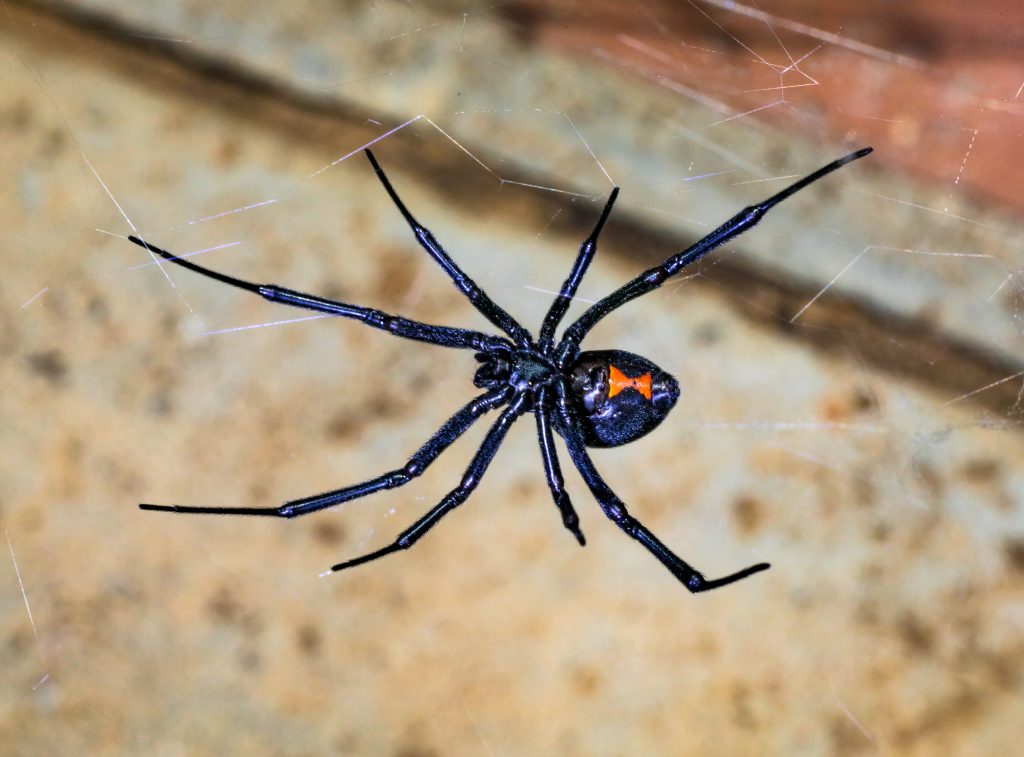
A black widow bite August leave only a small red mark, yet the pain can spread far beyond that spot. Muscle cramps may develop in the back, shoulders, chest, or abdomen even when the skin shows little swelling.
That contrast is what makes the bite so unsettling. Black widow venom acts mainly on nerves and muscles. It does not usually create the deep, worsening skin wound people often associate with serious spider bites.
Most people recover with proper care, and fatal cases are rare. Still, a suspected black widow bite should not be ignored when pain spreads, muscles tighten, or symptoms such as nausea, sweating, and a fast heartbeat begin.
What a Black Widow Bite Does Inside the Body
A black widow delivers venom through two small fangs. The amount can differ from one bite to the next. Some people experience only local pain, while others develop a stronger reaction throughout the body.
The venom interferes with communication between nerve endings and muscles. Under normal conditions, nerves release controlled signals that tell muscles when to contract and relax. Black widow venom causes an excessive release of those signals.
The effect is similar to a switch that gets stuck in the on position. Muscles continue receiving instructions to tighten, even when the person is resting. This explains why a bite on a hand or foot can produce severe muscle pain in the abdomen, chest, or back.
Muscle spasms, sweating, nausea, restlessness, elevated blood pressure, and a rapid heart rate are among the recognized effects of envenomation.
Why the Bite Mark may Look Minor
A black widow spider bite usually affects nerve function more than the surrounding skin. Redness, swelling, burning, or tenderness may appear, but the visible injury can remain small.
Two puncture marks are sometimes present, though they can be difficult to see. Their absence does not rule out a bite. Their presence also does not prove that a black widow caused the injury.
Doctors rarely identify a spider bite from the skin alone. They consider the symptoms, where the incident occurred, and whether the spider was seen or safely photographed.
How Black Widow Bite Symptoms August Progress
Black widow bite symptoms do not follow an exact schedule. The response depends on the amount of venom, the location of the bite, body size, age, and general health.
The table below shows a typical progression. It should not be treated as a guaranteed timeline.
| Time After the Bite | Symptoms That may Appear | What the Change may Mean |
| First few minutes | Pinprick feeling, burning, redness, or mild swelling | A local reaction has started |
| Within one hour | Increasing pain or soreness moving away from the bite | Nearby nerves and muscles may be reacting |
| Over several hours | Muscle cramps, sweating, nausea, back pain, or abdominal tightness | The reaction may be affecting the whole body |
| During the first day | Severe pain, muscle rigidity, elevated blood pressure, or rapid heartbeat | Medical monitoring may be needed |
| Over the following days | Decreasing cramps with lingering fatigue or soreness | The body is gradually recovering |
Early Symptoms Near the Bite Site
A black widow bite may feel like a needle prick when it happens. Some people notice immediate burning, while others become aware of the bite only after the area turns sore.
The skin August become red, pale in the center, or slightly swollen. Numbness or tingling can occur around the bite site. These changes are not unique to black widows and August resemble other insect bites or minor skin infections.
Symptoms That Spread Beyond the Skin
Pain may travel up an arm or leg before reaching larger muscle groups. Muscle cramps can come in waves or remain constant. Sweating may appear near the bite or across the face and body.
Other black widow bite symptoms include nausea, vomiting, headache, shaking, anxiety, and trouble sleeping. A stronger reaction can also increase heart rate and blood pressure.
Why the Abdomen, Chest, and Back August Hurt
The abdomen contains broad layers of muscle that can contract forcefully when nerve signals become overactive. The stomach may feel firm or rigid, and the pain can resemble appendicitis, kidney stones, or gallbladder trouble.
Back and shoulder pain have the same basic cause. Large muscle groups tighten repeatedly, then remain sore after the strongest spasms pass. The location of the worst pain may be several feet from the original bite.
Chest pain may also result from muscle contractions. It still requires medical attention because symptoms involving the heart or lungs can feel similar.
| Body Area or System | Possible Reaction | Why It Happens |
| Muscles | Cramps, spasms, stiffness, or soreness | Nerves repeatedly signal the muscles to contract |
| Abdomen | Tightness, rigidity, or severe pain | Large abdominal muscles contract forcefully |
| Skin | Redness, swelling, sweating, or goosebumps | Local irritation and automatic nerve responses |
| Digestive system | Nausea, vomiting, or stomach discomfort | Overactive nerve signals affect digestion |
| Heart and circulation | Rapid heartbeat or elevated blood pressure | The body’s automatic stress response becomes overstimulated |
| Nervous system | Headache, agitation, or trouble sleeping | Persistent signaling keeps the body alert |
| Chest and back | Tightness or painful spasms | Large muscle groups respond to abnormal nerve activity |
When a Black Widow Bite Needs Medical Attention
Contact Poison Control or a healthcare professional after a suspected black widow bite, especially when symptoms extend beyond the skin. Children, older adults, pregnant patients, and people with serious heart or breathing conditions may require closer observation.
Seek prompt medical attention for severe pain, repeated vomiting, heavy sweating, strong muscle spasms, chest discomfort, or a rigid abdomen. Call 911 for trouble breathing, seizures, collapse, confusion, or loss of consciousness.
The Poison Control black widow guide states that severe pain and muscle cramps August begin within a couple of hours. It also notes that deaths are rare and antivenom is needed in only a small number of cases. People in the United States can call 1-800-222-1222 for case-specific advice.
What to Do Before Help Arrives
Wash the bite site with soap and water. Place a cold pack inside a clean cloth and apply it for short periods. Keep the affected arm or leg elevated when practical.
Do not cut the wound, apply suction, or tie a tight band around the limb. These methods do not remove black widow venom and may damage tissue or restrict circulation.
A clear photograph of the spider may help with identification, but take one only from a safe distance. Never handle or trap a live spider.
How Medical Professionals Treat a Black Widow Bite
Black widow bite treatment is based on symptoms rather than the size of the bite mark. Mild cases may require wound cleaning, pain medication, and observation.
Severe muscle pain or spasms may require prescription pain relief, muscle relaxants, intravenous fluids, or hospital monitoring. Medical staff August track breathing, hydration, blood pressure, and heart rate.
Antibiotics do not neutralize venom. They are used only when a separate bacterial infection is present. Black widow antivenom may be considered when serious symptoms fail to improve with supportive care, but it is not used for every patient.
What the Clinical Data Shows
A frequently cited clinical study reviewed 163 confirmed black widow envenomations. The results help explain why treatment focuses on pain and muscle control.
| Study Finding | Reported Result | Why It Matters |
| Confirmed cases reviewed | 163 | Researchers examined documented black widow bites |
| Relief after initial intravenous morphine | 55% | More than half required no additional medication for relief |
| Relief after morphine and a benzodiazepine | 70% | Combined symptom control helped a larger share of patients |
| Calcium gluconate | Less effective | An older treatment did not provide dependable pain relief |
The study of 163 black widow envenomations reported relief in 55% of patients initially treated with intravenous morphine. Relief increased to 70% when morphine and a benzodiazepine were used together.
These statistics describe treatment in a clinical setting. They are not instructions for home care, and medication decisions depend on the individual patient.
How Black Widow and Brown Recluse Bites Differ
Many homeowners expect every dangerous spider bite to create an expanding wound. That pattern does not fit most black widow bites. Black widow venom primarily affects nerves and muscles. Brown recluse venom is more closely associated with tissue injury around the bite.
| Feature | Black Widow Bite | Brown Recluse Bite |
| Main effect | Disrupted nerve and muscle signaling | Local tissue injury |
| Common concern | Severe cramps and widespread pain | A blister or worsening skin lesion |
| Visible skin damage | Usually limited | August become more pronounced |
| Abdominal symptoms | Can be intense | Less characteristic |
| Main medical focus | Pain control and monitoring | Wound care and tissue monitoring |
An enlarging ulcer, darkening skin, drainage, or an open wound needs medical evaluation. The cause may be another spider, a bacterial infection, or an unrelated skin condition.
Where Black Widow Spiders Hide Around Homes
Black widow spiders prefer dark, sheltered places where webs remain undisturbed. Garages, crawl spaces, sheds, meter boxes, woodpiles, storage bins, and the space beneath outdoor furniture can provide suitable hiding spots.
Their webs look tangled and irregular rather than round and symmetrical. Most bites occur when someone reaches into a protected space or presses the spider against the skin.
Wear gloves when moving firewood, planters, boxes, or outdoor equipment. Shake out shoes and work gloves stored in a garage or shed. Use a flashlight before reaching behind stored items.
Homes in warm and humid areas such as Raleigh, Nashville, Jacksonville, and Augusta can provide long seasonal windows for spider activity. Keeping storage areas orderly and sealing gaps can reduce access to sheltered spaces.
Reducing Black Widow Activity Around Your Home
A black widow bite can produce severe muscle pain even when the skin mark looks small. The venom disrupts nerve signals, which may lead to muscle cramps, sweating, abdominal rigidity, nausea, and changes in heart rate or blood pressure. Medical care comes first when symptoms spread.
Long-term prevention requires attention to the places where spiders hide and hunt. ClearDefense Pest Control inspects web locations, entry points, sheltered areas, and nearby insect activity before selecting a targeted treatment approach. Request a pest control quote when black widow webs or recurring spider activity appear around your home.