
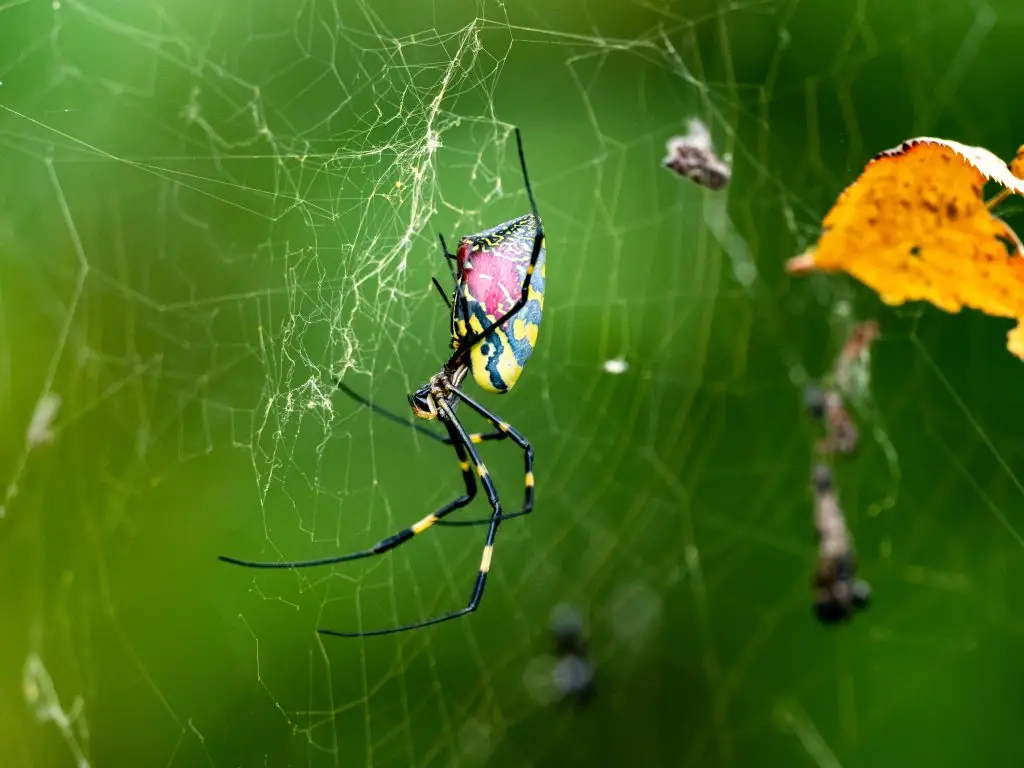
A large web can seem to appear overnight. One afternoon, the space between two trees is clear. By morning, a sheet of golden silk stretches across it, with a bright yellow spider hanging near the center.
You may call it a golden orb weaver, but that name does not identify one exact species. The spider could be a Joro spider. It could also be a native golden silk orb-weaver, which many homeowners call a banana spider.
Both spiders are large, colorful, and capable of building impressive webs. Their markings tell them apart more reliably than their size. Once you know what to check, you can decide whether the spider can stay where it is or whether the web is too close to the way your family uses the yard.
Is a Joro Spider a Golden Orb Weaver?
A Joro spider is one kind of golden orb weaver. The broader name refers to related spiders known for building round webs with silk that can look yellow or gold in sunlight.
The wording causes understandable confusion. “Joro spider” identifies a particular spider, while “golden orb weaver” describes a larger group. A Joro and a golden silk orb-weaver can therefore share several traits without being the same species.
Joros came from East Asia and were first confirmed in the United States in northeast Georgia in 2014. That location and date are worth mentioning because they help explain why sightings have become more common over time. Most homeowners, however, do not need a state-by-state range list to identify one in the yard.
Joro Spider Facts
| Feature | Checked Information |
| Spider group | Golden orb weaver |
| Origin | East Asia |
| First confirmed U.S. record | Northeast Georgia in 2014 |
| Female body length | Up to about 1 inch |
| Female leg span | Up to about 4 inches |
| Female colors | Yellow, dark blue-green or black, red, and pale markings |
| Male appearance | Much smaller, narrow, and brown |
| Most visible season | Late summer through fall |
| Eggs in one mass | Up to about 400 to 500 |
| Typical hatching period | April and August |
| Young spider movement | Tiny spiderlings can travel on wind-carried silk |
| Tendency to bite | Low during ordinary contact |
The measurements come from the Penn State Extension Joro spider guide, which lists an adult female body length of up to one inch and a leg span of up to four inches. Much of the spider’s dramatic appearance comes from those long, narrow legs.
How to Identify a Joro Golden Orb Weaver
A mature female is the easiest Joro to recognize. Her abdomen usually has broad yellow sections crossed by dark blue-green or black bands. The pattern looks brighter and more sharply divided than the coloring on many other orb-weaver spiders.
Look underneath the abdomen when the spider’s position allows it. Red markings on the lower surface are a useful clue, especially when paired with long black legs marked by yellow bands. Never reach into the web or try to turn the spider over.
The male can be easy to miss. He is much smaller than the female, with a narrow brown body that lacks her strong colors. You may find him near the side of a female’s web rather than in the middle.
What the Joro Spider Web Can Tell You
A mature Joro spider web may contain more than one flat circle. The female can build a main orb with extra silk around it and long support lines connected to trees, shrubs, posts, gutters, or other raised surfaces.
Sunlight can make the silk look gold, but web color alone does not settle the identification. Golden silk orb-weavers also produce yellowish silk. Use the abdomen, underside, legs, and web together.
Joros can build where people regularly walk or work. A web near a house does not mean the spider is trying to move indoors. It usually means the location offers stable supports and a steady supply of flying insects.
Joro Spider vs. Golden Silk Orb-Weaver
Homeowners often confuse the Joro with the golden silk orb-weaver. Both are large, and both suspend themselves in expansive golden webs during warm weather.
A close look at the abdomen and legs usually clears up the confusion. This comparison works best for mature females because young spiders and males look less distinctive.
| Feature | Joro Spider | Golden Silk Orb-Weaver |
| Status in the United States | Introduced | Native |
| Abdomen pattern | Broad yellow areas crossed by dark bands | Longer yellow or gold abdomen with pale spots |
| Lower abdomen | Often shows noticeable red coloring | Does not have the same bold red Joro pattern |
| Legs | Smooth-looking dark legs with yellow bands | Dark and yellow legs with brushlike sections |
| Web | Large, golden, and often surrounded by extra layers | Large golden orb web |
| Other common name | Joro | Banana spider or golden silk spider |
| Peak visibility | Late summer and fall | Warm months |
| Usual response to people | Stays in the web, hides, or retreats | Stays in the web, hides, or retreats |
A yellow garden spider is another possible look-alike. It has a black and yellow abdomen and often holds its legs in pairs, forming an X while resting. Its web commonly contains a thick white zigzag through the center, a feature that Joro webs lack.
Why Joros Become Easier to Spot in Fall
Joros begin spring as tiny spiderlings. They feed and grow through summer, but their early webs are small enough to disappear among leaves and shrubs.
By late summer, the females have grown substantially. They need larger webs, longer supports, and more open space to catch food. A spider that has occupied the property for months August suddenly seem new once its web reaches several feet across.
Fall brings mating and egg production. The female places her eggs inside a silk-covered mass that remains through winter after the adults die. The next generation hatches when warmer conditions return.
The University of Georgia Extension reports that one female August place about 400 to 500 eggs in a mass. It also identifies April and August as the usual hatching period.
What “Flying Joro Spiders” Really Means
Adult Joros do not fly. The phrase comes from ballooning, a natural behavior used by tiny spiderlings.
A spiderling releases a fine silk thread that catches moving air. Because the spider is extremely light, the thread August carry it away from the egg mass. This is one way young spiders spread through the surrounding area.
A full-grown female does not float across a yard in the same way. Her weight and size make the popular image of a giant flying spider misleading.
Are Joro Spiders Dangerous?
A female Joro is capable of biting, but ordinary activity around the web is unlikely to provoke one. The spider is more inclined to stay still, move away, or hide than to approach a person.
A Joro spider bite becomes more likely when the spider is squeezed, pinned against the skin, or held tightly. Do not pick one up or pull it from the web by hand. Give it room if you need to work nearby. According to Clemson Home and Garden Information Center, the spider is most likely to bite when someone grips its body or legs tightly.
A reported bite August leave a small, red, itchy welt. Wash the area with soap and water. Seek medical care for severe pain, spreading swelling, trouble breathing, or another reaction that causes concern.
What Joros Catch in Their Webs
Joros eat small animals that become trapped in their silk. Their prey may include flies, moths, beetles, leafhoppers, wasps, and other spiders.
That does not make a Joro spider a dependable form of mosquito control. A web catches insects that happen to fly into it, including species that do not bother homeowners. Researchers are still studying how established Joro populations affect native spiders and other parts of local food webs.
Web placement can tell you something about insect activity around the property. A porch light that draws moths each evening gives a golden orb weaver a steady food source. Dense shrubs, damp corners, and sheltered roof edges can offer both prey and strong attachment points.
Should You Remove a Golden Orb Weaver?
A golden orb weaver at the back of the property can usually remain where it is. The spider has food, the web does not interrupt daily activity, and contact with people is unlikely.
The answer changes when silk crosses a doorway, porch step, play area, grill, or regularly used path. Webs beside utility equipment or maintenance access points may also need to come down. The problem in these cases is placement, not the spider’s appearance.
For an accessible web, use a long-handled broom to clear the silk while keeping your hands away from the spider. Move slowly so it has an opportunity to retreat. A new web may appear if the same location still offers good support and plenty of insects.
Do not climb a ladder to reach a golden orb weaver on an upper eave or roofline. A large web is not worth the fall risk.
How to Reduce Large Webs Near the House
Removing one Joro spider web deals with what you can see. Changes around the structure make the location less useful to the next spider.
| Property Condition | Why Spiders Use the Area | Practical Change |
| Bright lights beside doors | Flying insects gather around the bulbs | Turn off unused lights or choose warmer-colored bulbs |
| Shrubs touching siding | Branches provide shelter and web supports | Trim plants back from the wall |
| Tree limbs over the roof | Limbs give spiders a route to gutters and upper levels | Prune branches that touch or closely overhang the structure |
| Leaks or damp corners | Moisture supports insect activity | Repair leaks and improve drainage |
| Open trash containers | Food residue attracts flies | Close lids and clean spills |
| Stored patio items | Undisturbed objects provide protected corners | Reduce clutter and move items periodically |
| Torn screens and exterior gaps | Openings allow insects and smaller spiders inside | Repair screens and seal practical entry points |
| Old webs around porches | Existing silk makes recurring activity harder to track | Remove reachable webs during routine exterior cleaning |
Lighting changes will not eliminate spiders by themselves. They can reduce the number of flying insects gathering beside entrances and windows. Pair that step with vegetation maintenance, moisture correction, and regular web removal.
When Spider Activity Calls for Professional Help
One seasonal spider in a distant tree does not point to a larger home problem. Recurring webs around entrances, upper eaves, covered patios, and other occupied spaces deserve a closer look.
The visible spider may be only part of the pattern. Strong anchor points, dense vegetation, exterior lights, and steady insect activity can make the same section of a home attractive year after year.
ClearDefense Pest Control evaluates where spiders are building and what draws them close to the structure. Treatment can be focused on the areas that need attention instead of treating every outdoor surface alike.
Making the Right Choice About a Golden Orb Weaver
A huge golden orb weaver may be a Joro, but the web’s color is only the first clue. Check the female’s striped abdomen, red lower markings, banded legs, and layered web before settling on an identification.
Then consider where the spider has built. A web away from the house can usually remain undisturbed. A web across an entrance or another active space has a practical reason to be removed.
Accurate identification keeps a large yellow spider from becoming a bigger concern than it needs to be. It also helps you recognize when recurring webs reflect conditions around the home that are worth correcting.
When webs keep returning in places your family uses, contact ClearDefense Pest Control. A technician can inspect the exterior and recommend a targeted response based on the spider activity around your home.