
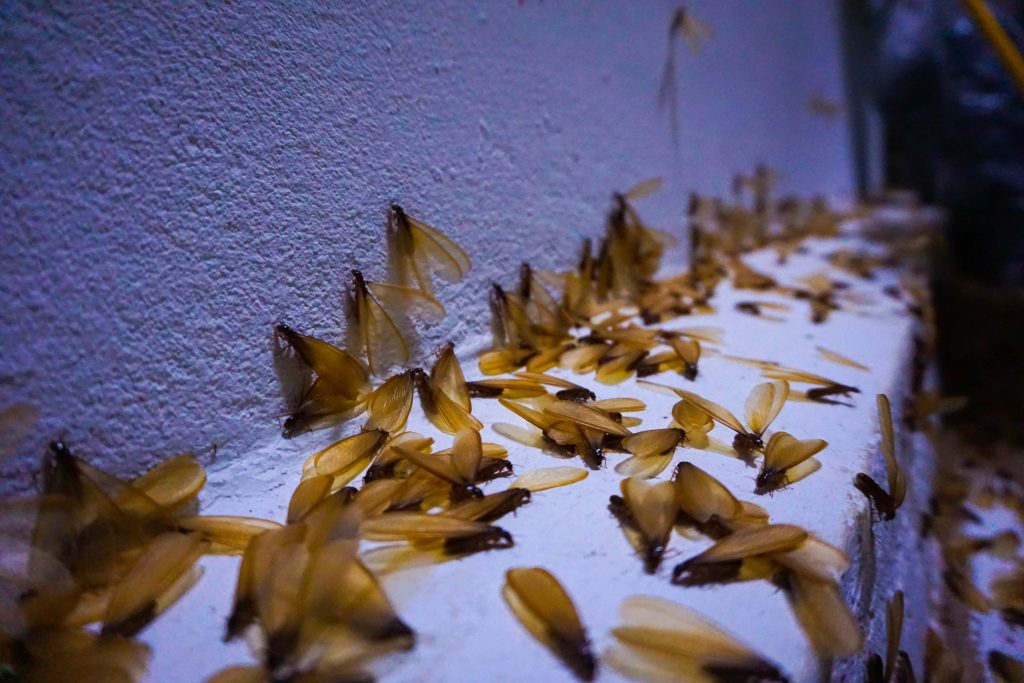
A sudden cloud of winged insects can catch any Austin homeowner off guard. You might see them circling a porch light after rain, gathering against a sunny window, or crawling out near a baseboard. A few hours later, the insects may be gone, leaving only a pile of thin wings behind.
Termite swarmers in Austin are reproductive termites that leave mature colonies to pair up and attempt to form new ones. The swarmers are not the termites that spend their time feeding on wood, but their appearance can reveal an established colony nearby. Where you find them matters just as much as what they look like.
An outdoor swarm near a stump does not prove that termites have entered your home. A large swarm coming from an interior wall deserves a faster response. Learning how to identify the insects, understand Austin’s termite season, and document the activity will help you make the right next move without jumping to conclusions.
What Termite Swarmers Are Doing Around Your Home
A termite colony contains different groups with specific jobs. Workers gather food and feed other colony members. Soldiers help defend the colony. Winged reproductive termites, commonly called swarmers or alates, leave when the colony is mature enough to reproduce.
The swarm usually begins when temperature, moisture, and light conditions line up. Hundreds or thousands of winged termites may leave at nearly the same time. They fly for a short period, land, shed their wings, and search for a suitable place to pair. Most never succeed because they dry out or become food for birds, ants, spiders, and other predators.
The insects flying around your window are not actively eating the trim. Worker termites cause structural damage, and they usually remain concealed in soil, mud tubes, or wood. Still, swarmers tell you that a mature colony exists somewhere nearby. An indoor exit point may place that colony beneath the slab, inside a wall, or close to another part of the structure.
How to Identify Termite Swarmers in Austin
Termite swarmers are often mistaken for flying ants because both insects can appear in groups during warm weather. Color is not a dependable way to separate them. Termite and ant species can both look brown, dark brown, or nearly black.
Body shape provides a better answer. A termite swarmer has a broad middle without a sharply pinched waist. Its antennae look straight or gently curved. All four wings are close to the same length and extend well beyond the body.
Flying ants have a narrow waist that clearly separates the chest and abdomen. Their antennae bend at an elbow, and their front wings are larger than their rear wings. Looking at several features together is more reliable than making a decision from one loose wing.
| Feature | Termite swarmer | Flying ant |
| Waist | Broad and fairly uniform | Narrow and pinched |
| Antennae | Straight or beadlike | Bent at an elbow |
| Front and rear wings | Similar in length | Front pair is larger |
| Body shape | Thick through the middle | Clearly divided sections |
| Shed wings | Matching wings may collect in piles | Wing piles are less common |
Loose wings often remain after the live swarmers disappear. Check window sills, sliding door tracks, bathroom floors, garage corners, and the space around exterior doors. Termite wings are thin, translucent, and similar in size. A group of matching wings indoors deserves closer attention even when no live insects remain.
Crushed or vacuumed insects become harder to identify, so photograph the activity before cleaning. Save several intact insects in a sealed container when possible. A pest professional can usually identify a complete specimen more confidently than a photograph of scattered wings.
When Termite Swarming Season Begins in Austin
What Influences Termite Swarming?
Termite swarming depends on the species and local weather conditions. Warm temperatures and rain can create conditions that encourage winged termites to leave their colonies.
Watch for winged termites and discarded wings around windows, doors, and other entry points. If you notice these signs, arrange a termite inspection to identify the activity and discuss the next steps.
Subterranean termite swarms in Austin are most common from late winter through spring. The timing varies with local weather conditions, so a calendar alone cannot predict when a swarm will appear. A warm spell after rain often creates favorable conditions because moist soil protects swarmers from drying out as quickly.
Austin does not have one fixed swarm date. A colony beside a sunny foundation may respond before one in a cooler, shaded area. Different termite species also react to different combinations of heat, moisture, and light.
According to Texas A&M AgriLife Extension, swarming starts as early as January or February in South Texas and occurs later in cooler parts of the state. The extension also explains that heat, light, and moisture help trigger flights, while each species has its own environmental requirements.
The visible flight may last only a few hours, but termite activity does not end when the swarm disappears. Workers remain concealed in the colony throughout the year. The swarm is a brief reproductive event, not the full life cycle of the infestation.
| Austin condition | How it can affect swarming |
| Rain followed by warmer weather | Moist soil can support a reproductive flight |
| Calm, bright conditions | Swarmers can leave the colony and move toward light |
| A warmer-than-usual winter | Swarming may begin earlier |
| Cool or dry spring weather | Activity may be delayed or less noticeable |
| Mature colony near a structure | A larger number of swarmers may appear at once |
What the Swarm Location Tells You
Seeing termite swarmers outdoors does not automatically mean your home is infested. Termites are common in Texas soil and often feed on dead roots, buried wood, tree stumps, landscape timbers, or fence posts. A colony can live in the yard without reaching structural lumber.
Pay attention to where the insects first appeared. Swarmers rising from a stump several yards from the building suggest outdoor colony activity. Insects coming from a foundation joint, porch post, garage wall, or gap around a utility line deserve more scrutiny.
An indoor swarm is more concerning because the insects may have emerged from a concealed colony within or directly beneath the structure. Texas A&M’s subterranean termite guidance states that indoor swarmers are a reliable sign of infestation, though a few can occasionally enter through open windows and doors.
The number of insects helps provide context. One swarmer beside an open patio door may have flown inside. Dozens emerging from a baseboard or gathering in an interior room point to a different situation.
| What you find | What it may mean | Best response |
| Swarm over a stump or wood pile | A mature outdoor colony is nearby | Inspect the home perimeter and monitor the area |
| Several insects near an open door | They may have flown indoors | Save a sample and check for an interior source |
| Large swarm inside a closed room | A colony may be in or beneath the structure | Arrange a professional termite inspection |
| Matching wings near a window | Swarmers landed and shed their wings nearby | Photograph the wings and inspect adjacent areas |
| Mud tubes with swarmers or wings | Subterranean termites may have structural access | Avoid disturbing the tubes before inspection |
Do not seal an apparent exit point before someone examines it. Closing a gap may hide useful evidence without affecting the colony. The swarmers may simply find another route into the room.
Signs to Check After a Termite Swarm
Swarmers and discarded wings are useful evidence, but they are not the only signs of termite activity. Subterranean termites build narrow mud tubes that protect them as they travel between soil and wood. These tubes can appear on foundation walls, garage slabs, crawl space supports, plumbing lines, or cracks in masonry.
Wood damage can be harder to recognize. Trim or framing may sound hollow when tapped because termites remove material beneath the surface. Painted wood can look blistered, rippled, or unusually thin. A screwdriver may penetrate badly damaged wood with little pressure, though homeowners should not pry into finished surfaces simply to test them.
Water damage, rot, and other insects can create similar symptoms. A stain beneath a window does not confirm termites, and cracked wood is not proof of an infestation. An inspection should separate actual termite evidence from ordinary wear, moisture damage, and unrelated pest activity.
The financial risk is one reason termite evidence deserves a careful response. The U.S. Environmental Protection Agency reports that termites cause billions of dollars in structural damage every year. Property owners also spend more than $2 billion annually treating them. Those national figures do not mean every Austin swarm leads to major repairs, but they show why accurate identification matters.
What to Do After Finding Termite Swarmers
Finding a group of winged insects indoors can feel urgent, but a careful response provides better information than spraying or cleaning immediately. Preserve the evidence first, then check the surrounding area without pulling apart trim or opening walls.
Photograph the Insects and Their Location
Take close photographs of the insects, loose wings, and any visible exit point. Then take a wider picture showing the nearby window, wall, door, or foundation area. Record the date, approximate time, recent weather, and whether the swarm began indoors or outside.
These details can help a technician understand the conditions surrounding the swarm. They are especially useful when the live insects disappear before the inspection.
Save a Few Specimens
Place several intact insects or loose wings in a sealed bag or small container. Keep the sample dry and label where you found it. A complete insect is easier to identify than a crushed swarmer or a blurry photograph.
After saving enough evidence, vacuum the remaining swarmers and empty the vacuum outside. Cleaning up the visible insects will not affect a colony hidden in the soil, walls, or structural wood.
Check the Surrounding Area
Inspect the immediate area without disturbing possible termite activity. Look along foundation walls, garage edges, door frames, plumbing penetrations, and places where wood touches soil. Note any damp siding, blocked gutters, irrigation spray, plumbing leaks, or standing water close to the house.
Do not seal a crack or opening where swarmers appeared. Closing the visible exit may hide useful evidence and cause the insects to surface somewhere else.
Avoid Unplanned Treatments
Do not spray random products into wall gaps, foundation cracks, or baseboards. Killing visible swarmers does not reach the worker termites that remain inside the colony. An unplanned application can also disturb activity that would help a professional trace the source.
Schedule a Termite Inspection
A termite inspection should identify the insect, locate visible activity, and check possible access points. The technician should also explain whether the evidence shows an active infestation, older damage, or conditions that could support future termite activity.
Treatment should follow the inspection findings. One insect near an open door may not justify the same response as a large swarm emerging from an interior wall.
Getting a Clear Answer After an Austin Termite Swarm
Termite swarmers in Austin are easiest to recognize by their broad waist, straight antennae, and four similar-sized wings. They are most common from late winter through spring, especially when warm conditions follow rain. Their location gives the sighting its meaning.
An outdoor swarm means a mature colony is nearby, but it does not prove that termites have entered the structure. A large indoor swarm, repeated wing piles, mud tubes, or damaged wood gives you a stronger reason to act.
Save a sample, photograph the location, and avoid disturbing possible entry points. ClearDefense Pest Control can also inspect the home, confirm whether the insects are termites, and explain the next step based on the evidence. That gives you a clear answer instead of a guess based on a few wings.