
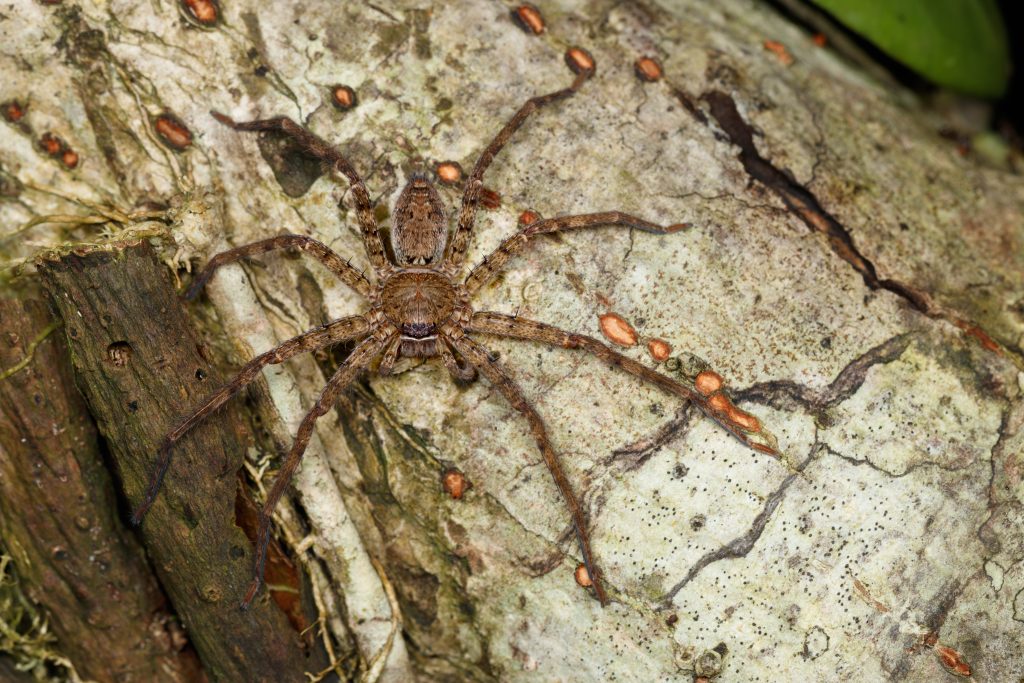
You spot a spider the size of your palm flattened against the garage wall, legs spread wide like a crab. Blink, and it’s already moved a foot sideways, faster than anything that size should be able to move. If you live in Florida, there’s a good chance that’s a huntsman spider, one of the largest spiders you’ll run into in a home here, and one of the most misidentified.
Huntsman spiders in Florida show up most often in warm, humid conditions. Attached garages, sheds, and the gaps around exterior walls give this spider exactly the kind of tight, sheltered space it looks for, and warm months make it more active and more visible indoors.
This guide covers how to identify a huntsman spider in Florida, why it’s so often confused with a brown recluse, where it tends to hide around a home, and whether a bite is actually something to worry about. By the end, you’ll know what you’re looking at and what, if anything, to do about it.
Key Takeaways
- A huntsman spider in Florida is typically the pantropical huntsman spider, identifiable by its flat body, crab-like leg stance, and wide leg span.
- Its size and brown coloring get it mistaken for a brown recluse, but the two aren’t related, and true brown recluses aren’t established in Florida.
- Its flattened body lets it squeeze into cracks around garages, closets, and exterior walls, which is why sealing off obvious entry points matters more than removing a single spider.
- Bites are uncommon and not generally considered medically serious, but frequent sightings across a home are worth having a professional take a look.
What Is a Huntsman Spider?
Before comparing it to other species, it helps to know where this spider actually comes from and why it goes by so many different names. The huntsman spider found in Florida is the pantropical huntsman, a species belonging to a family of spiders known as Sparassidae. UF/IFAS confirms it as an introduced species now found in subtropical parts of Florida, along with pockets of Texas, California, and the coastal Southeast, and notes that it’s also known as the giant crab spider or banana spider.
Where the Species Came From
The pantropical huntsman was introduced from Asia and has since spread through warm, humid regions around the world, including parts of the southern United States. In Northeast Florida, including Jacksonville and nearby communities, these spiders are more likely to turn up in garages, sheds, storage areas, and other sheltered spaces where temperatures stay more stable during cooler weather.
Their flat bodies help them slip into narrow gaps around doors, siding, and exterior walls. Warm, humid conditions support their activity for much of the year, while occasional cold snaps can push them closer to homes in search of shelter.
Common Names You Might Hear
You may also hear this spider called a giant crab spider, a banana spider, for its occasional appearance in shipped banana bunches, or, less formally, a housekeeper spider.
How to Identify a Huntsman Spider in Florida
Huntsman spiders in Florida have a distinct look once you know what to check for: a flattened body, a wide leg span, and a stance that spreads sideways rather than tucking underneath. Unlike wolf spiders, which are stockier and hairier with a more compact, hunched posture, a huntsman spider’s body stays low and thin relative to its leg length, which is part of what makes its movement look so unusual when it suddenly darts across a wall.
Size and Body Shape
Adults can reach a leg span of up to about five inches, making them one of the largest spiders found in the state. The body itself stays flat and low, an adaptation that lets the spider squeeze into narrow cracks and crevices around a home’s exterior and interior. That flatness is also the clearest way to separate it from a wolf spider or a large fishing spider, both of which have a rounder, more raised body even at a similar leg span.
Leg Position and Movement
Rather than tucking their legs beneath the body, huntsman spiders hold them out to the sides, which is where the “giant crab spider” nickname comes from. This positioning lets them move sideways, forward, or backward with equal speed, a trait most other large spiders don’t share. Because they hunt rather than sit in a web, they’re usually spotted mid-motion, often on a wall or ceiling rather than tucked into a corner, and that fast, sideways scuttle is frequently the first thing a homeowner notices before getting a good look at the spider itself.
Color and Markings
Most are brown, often with small dark spots near the leg bristles, a helpful detail for telling them apart from other large brown spiders.
Huntsman Spiders vs. Brown Recluse Spiders
Huntsman spiders are sometimes mistaken for a large brown recluse, but the two aren’t related and don’t carry the same level of concern. Getting this identification right matters, since a suspected brown recluse understandably raises more worry than a huntsman spider does, and mixing the two up can lead to unnecessary alarm.
Brown recluse spiders have a distinct violin-shaped marking on the upper body and are much smaller, with a body roughly the size of a quarter. Huntsman spiders lack that marking, have a noticeably flatter and wider stance, and are considerably larger overall, several times the size of a recluse once the legs are factored in.
There’s another point worth knowing: brown recluse spiders are not known to be established in Florida, which means a large brown spider found in a Florida home is far more likely to be a huntsman than an actual recluse. Body proportion is usually the fastest tell: a recluse’s legs stay close to its body, while a huntsman’s legs extend well beyond it.
Where Huntsman Spiders Hide in Florida Homes
Huntsman spiders don’t spin capture webs. Instead, they rely on speed and strong jaws to catch the insects they feed on, which means they need to actively seek out prey rather than wait for it. That hunting style is part of why they turn up in unexpected places around a property, and it’s also why a flat body matters so much to this species: it lets the spider squeeze through gaps most other large spiders can’t use, from narrow siding seams to the thin space under a garage door.
Indoor Hiding Spots
Indoors, they settle into the same quiet, sheltered spots as many other pests: behind furniture, inside closets, or tucked behind wall hangings, particularly during cooler stretches of weather when they move inside seeking warmth.
In Jacksonville and other parts of Northeast Florida, where winters bring occasional cold snaps, attached garages and storage areas are especially common entry points, since they offer shelter without requiring the spider to travel far from its outdoor hunting grounds.
Outdoor Hiding Spots
Outdoors, look for them under loose bark, in woodpiles, and around other undisturbed debris near the home’s exterior. Sheds, stacked firewood, and cracks along exterior walls all provide the kind of tight, sheltered space this spider looks for, and homes near wooded lots or dense landscaping are more likely to see activity simply because there’s more cover and more insect prey nearby.
Are Huntsman Spiders Dangerous?
This is the real question behind the identification, and the short answer is no. Huntsman spiders are not aggressive, and like most spiders in Florida, they play a useful role by feeding on insects such as roaches and moths. Bites are uncommon and are not generally considered medically serious, though they may cause localized pain or swelling, particularly if the spider is handled directly or trapped against skin.
When a Bite Can Happen
A huntsman spider bite can be locally painful, sometimes with noticeable swelling, if a person carelessly handles one or accidentally traps it, for example inside a shoe. For most healthy adults, symptoms resolve on their own without medical treatment. Contact Poison Control at 1-800-222-1222 or use webPOISONCONTROL for guidance after a suspected bite, especially if pain, swelling, or other symptoms worsen.
When to Call a Pest Control Professional
A single huntsman spider spotted once near a door isn’t unusual in Florida and doesn’t necessarily point to a bigger problem. Spiders wander, and an occasional sighting near an entry point is a normal part of living in a warm, insect-active climate. Regular sightings across multiple rooms tell a different story: that pattern can point to insects, shelter, or accessible entry areas supporting activity somewhere in or around the home, though it doesn’t automatically mean a full infestation.
For homeowners in Jacksonville and the surrounding Northeast Florida area, ClearDefense Pest Control offers a recurring spider-control service that includes an assessment of common spider hotspots and entry points, exterior treatment in areas where spiders commonly collect, and removal of spider webs. Visits include a 30-day return to address early activity, and service continues on a quarterly schedule with re-service available for covered pest activity between visits. After each visit, a technician provides a Defense Report explaining what was found, where treatment was applied, and which products were used.
Huntsman Spiders in Florida: Bottom Line
A huntsman spider crossing your wall is usually more startling than serious. Most Florida homeowners never experience anything beyond a one-time sighting, and knowing the size, shape, and leg stance covered above is enough to rule out anything more concerning, like a brown recluse.
Repeated appearances, especially across more than one room, are the exception worth acting on. In that case, professional spider control addresses the exterior areas and hotspots where spiders and other covered pests commonly gather, along with documented visits that show exactly what was treated and where.
If large spiders or recurring spider activity keep appearing around your Jacksonville-area home, contact ClearDefense Pest Control for a quote. A technician can assess the activity and recommend the spider-control service that fits your property.
Frequently Asked Questions
Are huntsman spiders venomous?
Huntsman spiders do produce venom to subdue insect prey, the same as most spiders. That’s different from posing a health risk to people. Unlike Florida’s genuinely venomous species, such as the black widow, a huntsman bite is a minor, localized reaction at most, and it’s not classified as dangerous to humans.
How can I tell a huntsman spider apart from a brown recluse?
The fastest test is leg span. A brown recluse rarely spans more than an inch, including its legs, while a huntsman spider can reach several inches across. Recluses also carry a violin-shaped mark near the head that huntsman spiders never have. If you’re still unsure, photograph the spider rather than handling it directly.
When should I call pest control about huntsman spiders?
One sighting in a garage or shed isn’t a strong signal on its own. Spiders showing up again within days, or appearing in living areas rather than storage spaces, are better indicators that something nearby is drawing them in. At that point, a ClearDefense technician can inspect the property and recommend next steps.