
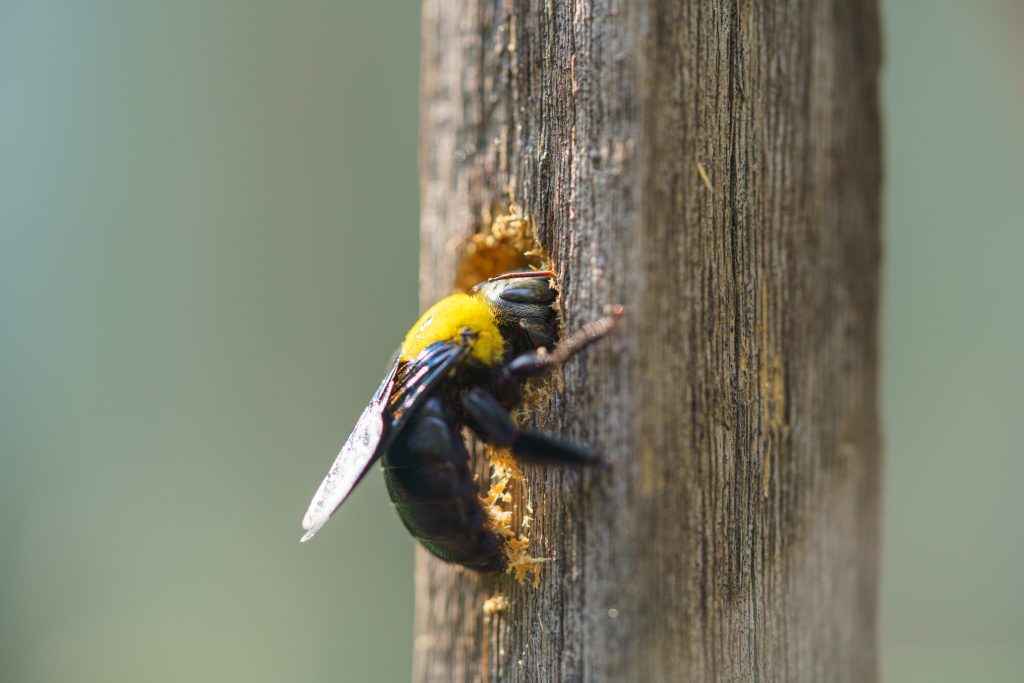
You walk onto the porch and see a large black bee circling one railing. A few seconds later, it disappears into a clean round hole in the wood. If you are dealing with a carpenter bee in North Carolina, that combination is one of the strongest clues.
Carpenter bees are native pollinators, but females also excavate wood to build nesting tunnels. One hole rarely means serious structural damage. Repeated nesting in the same porch, deck, trim board, or eave can create a larger problem over several seasons. This guide will help you identify the bees, check common nesting areas, understand their seasonal activity, and decide when carpenter bee control makes sense.
How to Identify the Carpenter Bee North Carolina Homeowners See
Carpenter bees are large, heavy-bodied bees that can resemble bumblebees from a distance. The abdomen gives you a useful visual difference. A carpenter bee usually has a smooth, shiny black abdomen, while a bumblebee looks much fuzzier across the same area.
North Carolina is home to more than one large carpenter bee species, but most homeowners do not need to identify the exact species. The more useful question is whether the bee is simply visiting flowers or repeatedly entering wood on the house.
Carpenter Bee Holes and Other Signs
The nesting hole is often easier to identify than the insect itself. According to NC State Extension’s guide to stinging insects, carpenter bee holes are typically round and about one-half inch across. Fresh excavation may leave sawdust below the entrance, while yellow or brown staining can develop underneath an active nesting area.
| What You Notice | What It May Mean | What to Check Next |
| Round hole about 1/2 inch wide | Possible carpenter bee tunnel | Look below it for fresh sawdust |
| Large black and yellow bee | Carpenter bee or bumblebee | Check whether the abdomen is shiny or fuzzy |
| Sawdust under a board | Recent boring | Watch the opening for a returning bee |
| Yellow-brown staining | The hole may be in use | Inspect nearby wood for more entrances |
| Bee circling one porch or eave | A nest may be close | Check sheltered wood in that area |
Do not make the call based on one bee moving through the yard. Watch where it goes. A bee that keeps returning to the underside of the same deck rail gives you much better evidence than one feeding on flowers.
Carpenter Bee vs. Bumblebee
Bumblebees usually nest in cavities rather than boring clean holes into lumber. They also have hairy abdomens that look soft or fuzzy.
Carpenter bees look smoother through the rear half of the body. If you see that shiny abdomen together with a round hole in wood, you have a much stronger identification.
Why Carpenter Bees Drill Into Wood
Carpenter bees do not eat lumber. Females use their jaws to remove wood and create sheltered galleries where their young develop.
The female starts by boring into the surface, then turns and follows the grain. She divides the carpenter bee tunnel into individual brood cells and supplies each one with pollen and nectar before laying an egg.
Where Carpenter Bees Nest Around Homes
Porches and decks offer several sheltered surfaces that can attract nesting females. Eaves, fascia boards, exposed beams, pergolas, fence posts, railings, and wooden outdoor furniture can also provide suitable nesting sites.
Look underneath these surfaces, not just at the face of the board. A carpenter bee hole may sit on the bottom edge of a railing or under an overhang where you will not notice it unless you crouch down or look up.
| Area to Inspect | Why It Deserves Attention | Common Sign |
| Porch railings | Sheltered sides and exposed wood | Hole along an underside or edge |
| Deck framing | Large amount of accessible lumber | Sawdust beneath a rail or joist |
| Eaves and fascia | Protected locations near the roof | Bees entering the same spot repeatedly |
| Pergolas and beams | Wide exposed wooden surfaces | Several holes on one section |
| Outdoor furniture | Often remains outside through spring | Fresh boring under seats or arms |
| Fence posts and boards | Numerous edges and sheltered faces | Localized holes on one board |
Two-story homes can make inspection harder. You may see carpenter bees circling the roofline long before you can see a hole in the fascia from the ground.
When Carpenter Bees Are Active in North Carolina
Carpenter bees in North Carolina become much easier to notice during spring. Adults commonly emerge during April and May after spending the colder months inside old galleries.
You may go through winter without seeing a single bee around the deck, then notice several within a short period once warm weather arrives. Males often patrol areas near old nesting sites, while females prepare galleries for the next generation.
What Happens Inside Carpenter Bee Tunnels
The entrance hole only shows you where the gallery starts. The tunnel itself can continue several inches through the board.
Typical galleries run about 6 to 7 inches, although some new tunnels exceed 1 foot. Completed galleries commonly contain 6 to 7 brood cells. Development from egg to adult generally takes about 5 to 7 weeks.
| Stage or Feature | Typical Figure or Timing | Why It Matters |
| Spring emergence | April to May | Old nesting areas may become active again |
| Entrance hole | About 1/2 inch | Useful identification clue |
| Typical tunnel length | 6 to 7 inches | Damage extends beyond the visible entrance |
| Longer tunnel | Can exceed 1 foot | A small hole can hide more excavation |
| Brood cells | Usually 6 to 7 | One gallery can hold several developing bees |
| Development period | About 5 to 7 weeks | New adults may appear later in summer |
New adults emerge later in the season and spend more time feeding outdoors. As colder weather returns, carpenter bees may use existing galleries for shelter again.
How Much Carpenter Bee Damage Should You Worry About?
One carpenter bee hole does not mean your porch is structurally unsafe. Carpenter bee damage becomes more concerning when the same piece of wood collects new or expanded galleries year after year.
The visible opening can also make the damage look smaller than it is. A gallery continues behind the surface, and returning bees may extend an old tunnel or add branches inside the same board.
Why Repeat Nesting Matters
NC State University News’ 2025 carpenter bee guidance explains that reused galleries can become longer and more branched over time. A porch beam with several years of nesting activity deserves more attention than one fresh hole in otherwise sound wood.
Look at the full section of lumber. Several openings, old stains, fresh sawdust, and new boring in the same area can point to repeated use.
Carpenter Bee Damage vs. Termite Damage
Carpenter bees and termites damage wood for completely different reasons. Termites consume material from the wood. Carpenter bees excavate it to create nesting galleries.
That distinction matters when you assess the problem. Carpenter bee damage is usually concentrated around individual tunnels rather than spread through the wood as a food source. Repeated nesting can still weaken or scar boards over time, especially when numerous galleries collect in one area.
Are Carpenter Bees Dangerous?
You are standing beside the deck when a large bee flies toward you, stops, then circles back again. That can feel aggressive, but the bee doing the hovering is often a male.
Male carpenter bees cannot sting. They patrol areas around nesting sites and may repeatedly approach people who walk into that space. Female carpenter bees can sting, but they are much less likely to do so unless they are handled or directly disturbed.
Carpenter Bees Also Help Pollinate Plants
Away from your porch or deck, carpenter bees serve a useful role. They collect pollen and nectar from many kinds of flowering plants.
The USDA Natural Resources Conservation Service identifies the eastern carpenter bee as a common generalist forager across the eastern United States. That is why a carpenter bee feeding in your garden is different from a female drilling into a fascia board.
The goal is not to treat every large bee in the yard as a pest. Pay attention to where the bees are nesting and whether they are repeatedly excavating wood on the house.
How to Prevent and Control Carpenter Bees
There is no single household trick that makes every wooden porch, deck, or eave permanently resistant to carpenter bees. Practical carpenter bee prevention starts with inspecting vulnerable wood and keeping track of places that have been used before.
Painted or finished wood may be less attractive in some situations, but coatings should not be treated as guaranteed protection. Check exposed edges, older nesting sites, damaged boards, and sheltered areas when spring begins.
Check Old Carpenter Bee Holes First
Walk around the house before spring activity becomes heavy. Look underneath railings, around deck framing, along fascia, and beneath roof overhangs where carpenter bee holes appeared in previous years.
Fresh sawdust is especially useful because it points to recent excavation. If you find it below an old entrance, watch the hole for several minutes and see whether a bee returns.
Do Not Plug an Active Carpenter Bee Tunnel Too Soon
Closing an entrance while bees are still inside can create another problem. A trapped carpenter bee may chew a separate exit through the wood.
Determine whether the gallery is active before repairing it. Regular bee traffic, fresh sawdust, and newly exposed wood around the entrance give you better information than the age of the hole alone.
When Professional Carpenter Bee Control Makes Sense
Professional carpenter bee control is worth considering when several active holes appear in the same structure, bees return to the same wood each spring, or the nesting area is difficult to inspect safely. It is also useful when identification is uncertain. Carpenter bees, bumblebees, honey bees, wasps, and hornets can look similar from a distance, but they do not nest or behave the same way.
ClearDefense Pest Control can identify the pest, inspect the affected wood, and address carpenter bee activity around difficult areas of the home. ClearDefense technicians can also reach eaves up to 25 feet when needed, which matters when nesting is concentrated along a second-story roofline.
If carpenter bees keep returning to your home each spring, contact ClearDefense Pest Control to have the nesting area inspected. Catching repeat activity while it is concentrated in a few boards can help limit additional tunneling and give you a clearer plan for repairs and future prevention.